
Installments and collections
Know what every buyer owes, what has been paid, and what needs attention today.
Estarivo tracks installment plans for every sale across all your estates: schedules, verified payments, balances, overdue amounts, receipts and allocation eligibility, in one place your finance and sales teams share.
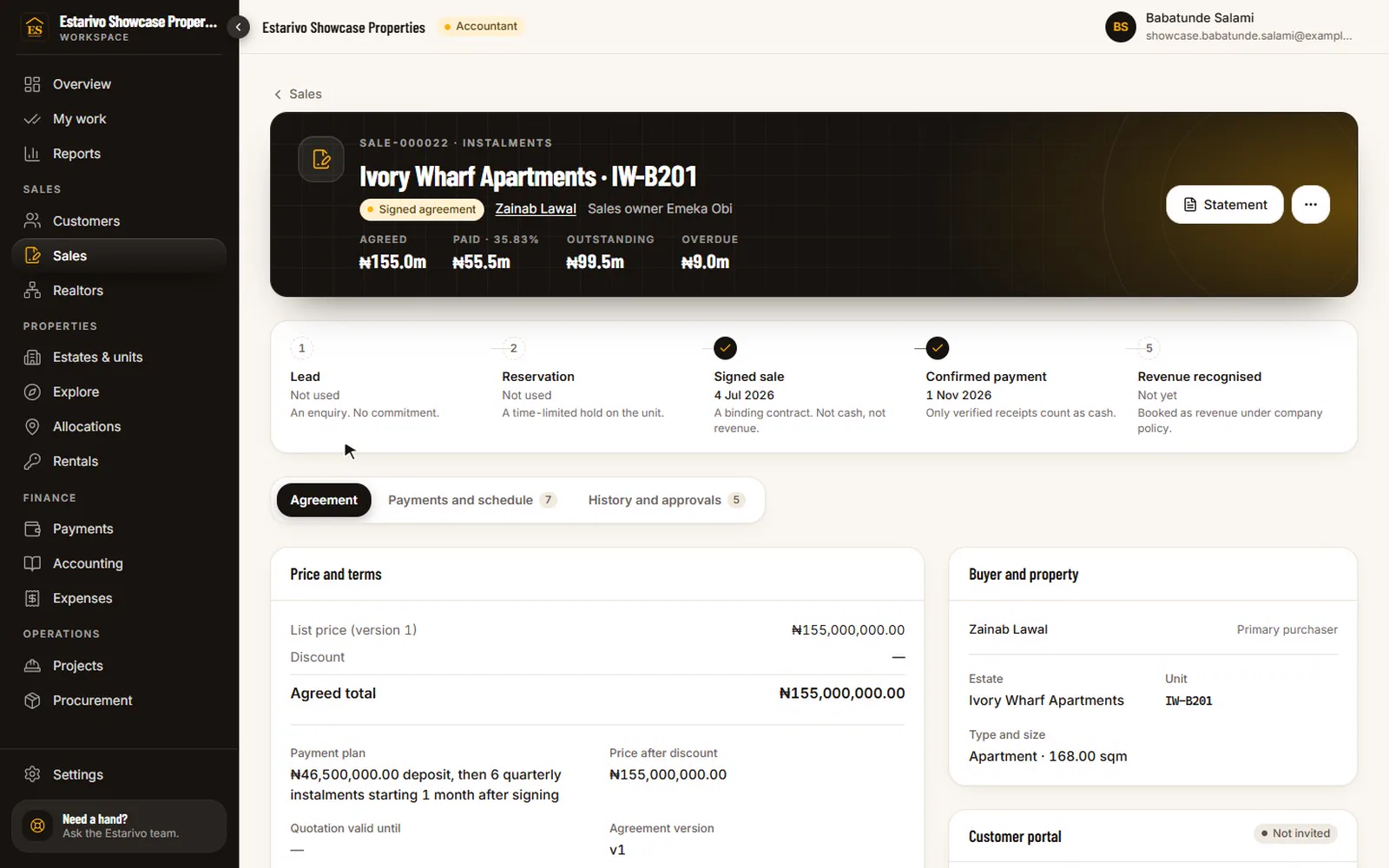
Recorded in Estarivo · demonstration company, fictional data · 35s · What it shows
- Every sale across the estates, with what has been paid and what is outstanding
- One signed sale: agreed price, paid to date, outstanding and overdue
- The installment schedule: paid, part-paid, due and overdue installments
- A payment the customer reported, waiting for finance to verify it
- A second person confirms the money arrived before it counts
- The balance updates and an official receipt is issued
Where it goes wrong
Installment sales are easy to make and hard to keep track of.
A land company selling across three or four estates can have hundreds of buyers on different plans at the same time: a deposit and twelve monthly payments for one, quarterly for another, a custom plan negotiated for a corporate buyer. Each spreadsheet row is a promise of money that has to be chased, confirmed and receipted.
The usual problems are familiar. A customer sends a screenshot of a transfer and it's counted before anyone checks the bank. Two staff members update the same sheet differently. A buyer calls to ask their balance and nobody can answer quickly. Allocation letters go out to someone who is still owing. Realtors ask about commission on payments that were never confirmed.
Estarivo is built so that a payment counts only when it has been verified, and every figure that depends on it updates from that one record.
How a payment moves through Estarivo
From signed agreement to receipt, with a check at the point that matters.
Step 1: The sale is signed
Price, approved discount, fees and the payment plan are fixed on the agreement. The schedule is generated from the plan: deposit, then monthly, quarterly or custom installments.
Step 2: The customer pays
They transfer to your account and tell you, or your staff record what the customer says was paid. In Estarivo that is a claim, not cash: it doesn't move the balance yet.
Step 3: Finance verifies
A second person confirms the money against the bank statement or the bank reference, with a note of how they checked. Only then is the payment posted.
Step 4: Everything updates
The installments are marked paid in order, the balance and overdue amount change, an official receipt is issued, the ledger is posted, and commission milestones are rechecked.
Step 5: Allocation follows the rules
When the payment conditions your company sets are met (for example 100% paid with nothing overdue), the sale becomes eligible for allocation, which has its own approval.
The recording at the top of this page shows these steps in the real application: a signed sale, its schedule, a pending payment verified by a second person, and the updated balance and receipt.
What you can do
The details installment companies deal with every month.

Flexible plansOutright, deposit plus installments, monthly, quarterly or custom schedules per sale.
Partial paymentsPart-payments are applied to the oldest installment first; the remainder stays visible.
Outstanding and overdueBalances per sale and per customer, with grace periods and overdue amounts that update daily.
VerificationClaims from customers or staff wait for finance; matching to a bank statement line where your bank feed or statement import is set up.
ReceiptsOfficial, numbered receipts in your company's brand, issued when a payment is verified; reversals go through approval.
RemindersScheduled reminders to customers before and after due dates, and notices to the realtor on the account, within limits you set.
Reschedules and creditsApproved reschedules keep the history; overpayments sit as customer credit until applied or refunded through approval.
Collections viewWho owes what, for how long, and what has been promised, so collections staff work from one list.
Allocation eligibilityYour conditions (percentage paid, nothing overdue, no dispute) are checked before a plot or unit can be allocated.
Customer portalBuyers can see their own schedule, payments and receipts, and report a payment for verification.
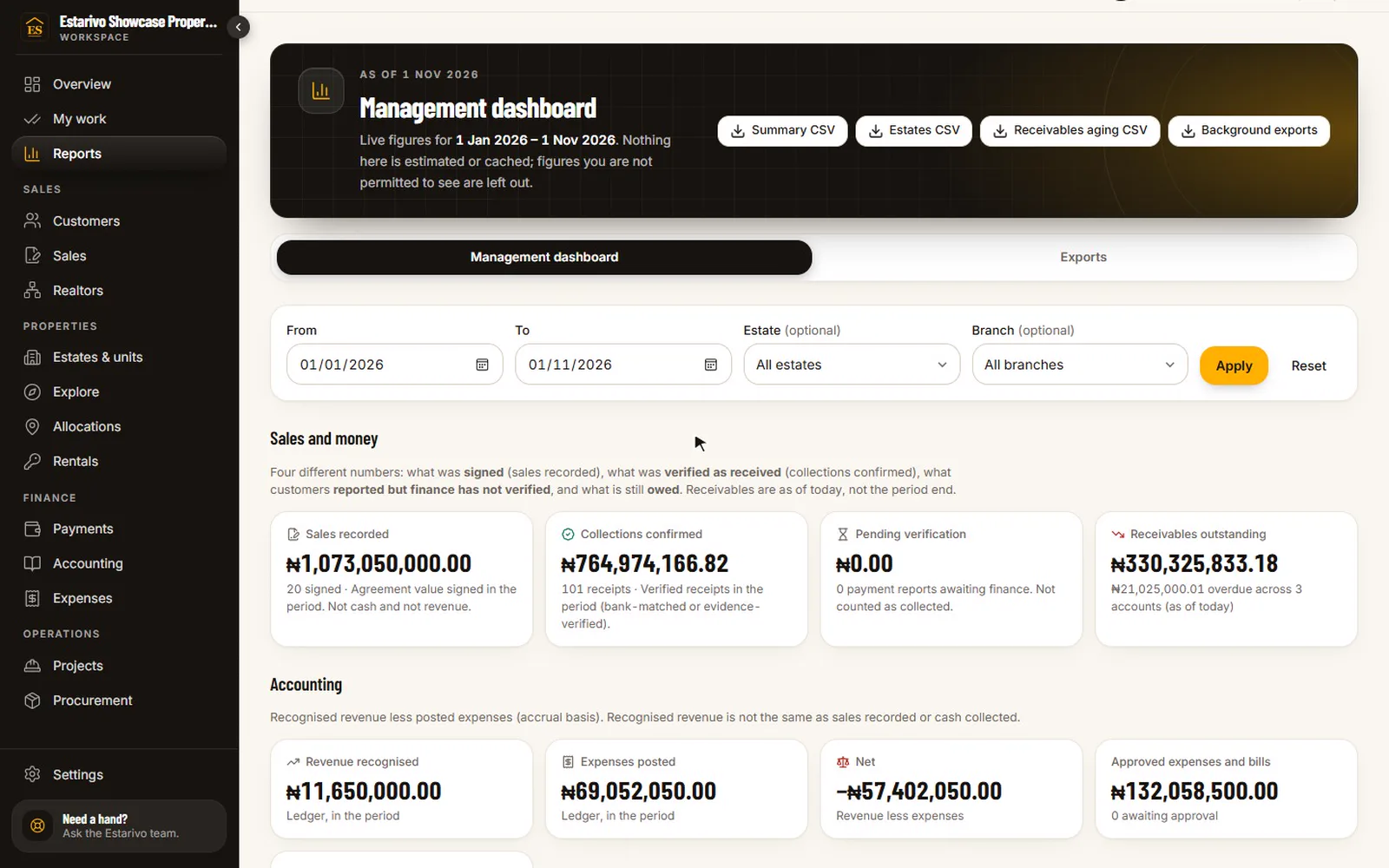
Recorded in Estarivo · demonstration company, fictional data · 18s · What it shows
- Management dashboard: sales, collections and receivables from live records
- Collections: who owes what, how overdue, and what has been promised
- Financial reports produced from the posted ledger
Collections and accounting
Collections you can reconcile.
Every verified payment posts to the general ledger, so the receivables your collections team chases are the same receivables your accountant reports. A signed sale raises the receivable; a verified receipt reduces it; a reversal is approved and posted, never deleted.
Questions
Questions companies ask us about installments
Can customers pay online?+
Estarivo connects to a company's own Paystack or Flutterwave account so buyers can pay from the portal, with the payment confirmed through the provider. The money goes to your account, not to Estarivo. These connections have been tested against the providers' test environments; each company completes a live test when it connects its account.
What happens when a customer pays less than the installment?+
The amount is applied to the oldest unpaid installment, the balance shows what is still due, and the overdue amount is recalculated.
Can we import buyers who are already half-way through their plans?+
Yes. Existing sales can be imported with their schedules and payment history; payments made before your cutover date are kept as history and not posted again as cash.
Do realtors see their customers' payments?+
A realtor sees the payment status of the customers they are credited with, and their own commission on them, but not other realtors' customers.
One system
Connected to the rest of your company
- Accounting & finance Every verified payment posts to the ledger and the receivables report.
- Realtors & incentives Commission milestones follow verified payments, not promises.
- CRM & customer portals Buyers see their own schedule and receipts in your portal.
- Development & construction Allocation and handover follow payment and construction status.
- WhatsApp operations Payment notices through your own WhatsApp Business number.
- Migration, training & support Bring existing buyers over with their schedules and history.
See your installment buyers in one place.
We'll walk you through a sale, its schedule, a payment verification and the receipt, and talk through how your current records would come across.