
Accounting and finance
Books that follow the business, not the other way round.
Estarivo is a double-entry accounting system built into the same records your sales, collections, procurement and realtor teams use. Sales, receipts, supplier bills, payroll and commissions post to the general ledger as they happen, so the reports reflect the company as it is today.
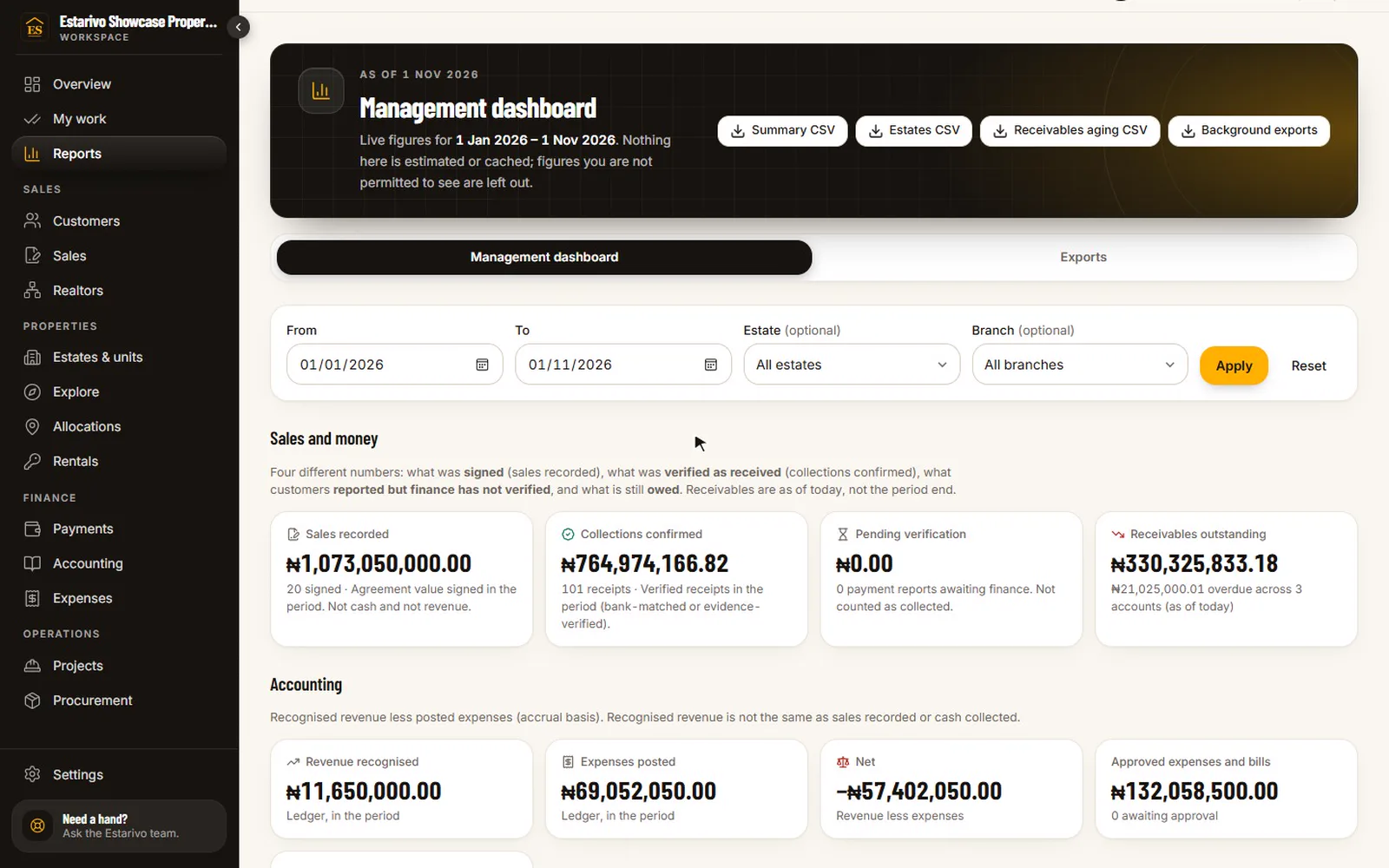
Recorded in Estarivo · demonstration company, fictional data · 18s · What it shows
- Management dashboard: sales, collections and receivables from live records
- Collections: who owes what, how overdue, and what has been promised
- Financial reports produced from the posted ledger
The month-end problem
Accounts usually learn about a sale weeks after it happened.
In many property companies, sales live in one spreadsheet, payments in another, supplier invoices in a file, commissions in a WhatsApp thread, and the accountant rebuilds the picture at month-end. By the time management sees the numbers, they are already old, and nobody is quite sure they agree.
Real estate accounting has its own complications: money received before a plot is allocated, installment receivables that run for years, development costs spread across estates and phases, deposits held for tenants, commission owed only when a buyer reaches a payment milestone, and VAT and withholding tax on supplier bills.
In Estarivo the accounting is a consequence of the work. Your team records the sale, verifies the payment, approves the bill; the journals follow from those records and balance.
What is included
From the chart of accounts to the cash-flow statement.

General ledgerChart of accounts, journals with draft and approval, periods you open and close.
ReceivablesRaised at signing, reduced by verified receipts; aged by customer, sale and estate.
PayablesSupplier bills from purchase orders, approvals, payments and payables aging.
Expenses and budgetsExpense claims and payments against categories, cost centres and budgets.
Tax on billsConfigurable VAT and withholding tax, with exemptions approved by a second person.
Bank reconciliationStatement imports (CSV or Excel) with duplicate detection, matching and sign-off.
Project costsBills, materials and labour charged to a project and its estate, against its budget.
Commission liabilitiesCommission accrued when earned, payable when approved, cleared when paid out.
Financial reportsTrial balance, general ledger, profit and loss, balance sheet, cash flow, and estate summaries.
Controls
A second pair of eyes where money is involved.
Payment verification, refunds, receipt reversals, discounts, journal approval and supplier payments follow maker-checker rules: the person who records an action cannot approve it, and approval limits can be set by amount. Every change is kept in an audit trail; posted entries are reversed, never edited away.
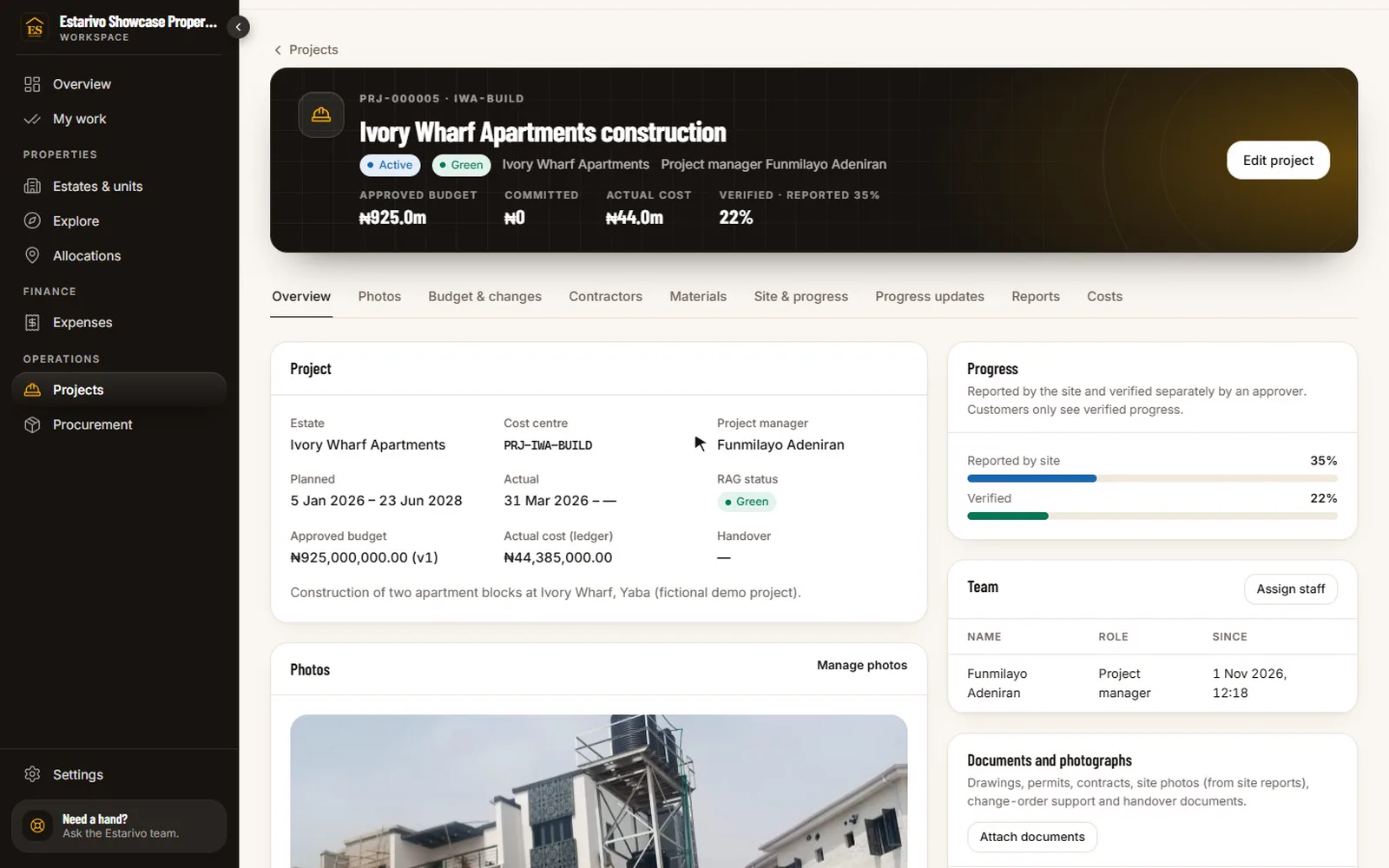
Recorded in Estarivo · demonstration company, fictional data · 15s · What it shows
- Projects linked to estates, with budget, cost and verified progress
- One project: approved budget, commitments and posted costs
- The progress timeline: verified site reports and published customer updates
- Procurement: purchase orders and supplier bills charged to the project
Investor capital and payouts
Integrations and your accountant
Questions
Questions finance teams ask
Is a signed sale recorded as revenue?+
No. A signed agreement raises a receivable; cash is recognised only when a payment is verified, and revenue is recognised under the policy your company sets.
Can we see figures per estate?+
Yes. Sales, collections, receivables and project costs can be reported per estate, and the management dashboard can be filtered by estate and date range.
Can we bring opening balances from our old books?+
Yes. Opening receivables per sale, customer credits, supplier payables, bank balances and deposits held are posted on your cutover date against opening balance equity.
How is investor money recorded?+
If your company runs investment arrangements, verified capital is posted as a liability to the investor or as participation capital, never as sales revenue. Investor payouts post when they are settled, not when they are approved, and the investment sub-ledger is reconciled to the general ledger.
Who can see the financial reports?+
Only people whose role includes financial reporting. Sales staff and realtors see their own work, not the company's accounts.
One system
Connected to the rest of your company
- Installments & collections Verified customer payments become receipts and ledger entries.
- Development & construction Supplier bills and materials are charged to projects and budgets.
- Realtors & incentives Commission accruals, approvals and payout batches post automatically.
- Investment management Investor capital as a liability, settled payouts and register reconciliation.
- Rentals & facilities Rent receipts, deposits held and property expenses in the same books.
- Migration, training & support Opening balances and history imported on your cutover date.
See your numbers come from your operations.
We'll show the ledger, receivables and reports on a demonstration company, and talk through your chart of accounts and how your opening balances would move across.